The past week has been historic, and a great personal triumph for President Trump.
He had help, starting with the enemies of Israel and America. The Iranians thought their nuclear facilities impregnable. They weren’t. Hezbollah believed it controlled Lebanon and that its thousands of rockets could obliterate Israel. That was wrong. Hamas believed the Oct. 7 attack would lead to Israel’s destruction. Instead the Jewish State unleashed a ferocious, unrelenting response.
Israel decapitated Hamas and depleted its ranks, smashed Hezbollah’s hold over Lebanon, and alongside the U.S. severely damaged or destroyed Iran’s nuclear labs.
As the Israeli military secured victories, Mr. Trump stepped into the diplomatic fray. He sent a New York real-estate pal, Steve Witkoff, to open negotiations while Secretary of State Marco Rubio patiently worked behind the scenes.
The president’s son-in-law Jared Kushner helped move the deal to conclusion while Mr. Trump cajoled, twisted arms and, when necessary, sweet-talked friends and foes alike. This week war-weary Israel welcomed home the remaining hostages. Its enemies have been demolished. The pulverization of Gaza has ceased. And world leaders now hail a man many of them dislike.
At home, the peace agreement will have some practical political benefit. It will likely bring a modest improvement in the president’s popularity, which sat at 45% approval and 52.2% disapproval in the RealClearPolitics average the day before the deal. In coming weeks, polls will also probably show Mideast peace is the second major issue—deporting violent criminal aliens being the other—on which Mr. Trump enjoys the support of almost all Republicans, a majority of independents and a small but consequential number of Democrats.
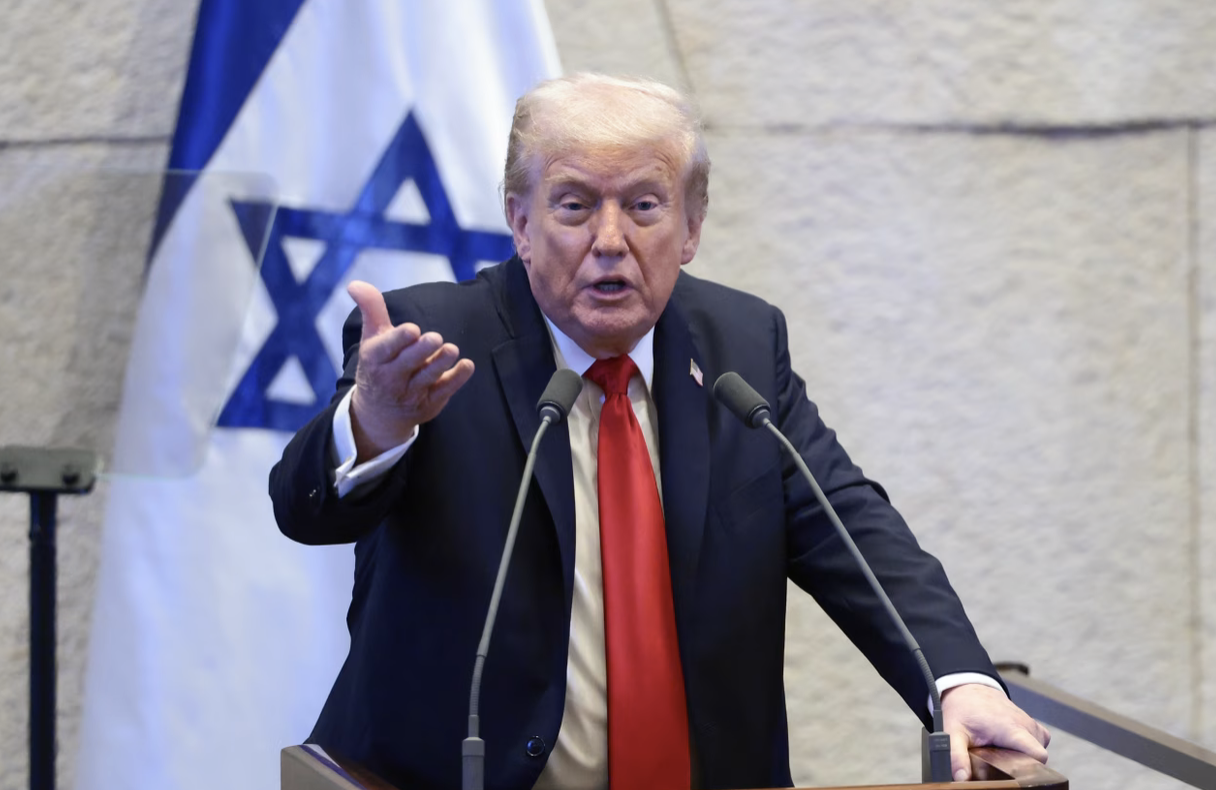
The president’s speech to the Israeli Knesset was a powerful moment. It would have been better without shots at Hillary Clinton and Presidents Obama and Biden. When the world was ready to see Mr. Trump as big and strong, he struck some petty, small notes.
The president’s triumph is likely to make more of an impact on history than at next year’s ballot box. His peace-making predecessors found that voters cared more about domestic controversies and the economy than presidential success on the global stage. President Dwight Eisenhower ended hostilities in Korea with an armistice six months into office. In the following year’s midterms, the GOP lost both chambers and eight governor’s offices. President George H.W. Bush oversaw the short and stunningly successful 1991 Gulf War. In the 1992 election, Bush still lost decisively to Bill Clinton.
Voters are fickle. They’ll happily pocket peace deals abroad and move on. The economy almost always re-emerges as the No. 1 issue. And calls for change invariably fare better in midterms than do promises of more of the same.
Though it will take time to show up in the polls, the government shutdown is also likely to limit any bounce the president gets from the historic agreement. Voters were already sour before the government closed.
It’s also vital to remember that only three of the 20 points in Mr. Trump’s peace plan have been fulfilled: The shooting has ended, Israeli hostages have been returned, and Israel has freed nearly 2,000 prisoners.
Those steps are enormously important, but there are still 17 items on the checklist. They’re harder. They include making Gaza a “deradicalized terror-free zone that does not pose a threat”; Hamas’s agreeing “to not have any role” in Gaza’s governance, even indirectly; and a “process of demilitarization.” Rebuilding Gaza under a transitional government. A new “International Stabilization Force” to provide “long-term security.” A “special economic zone” and foreign investment to “create jobs, opportunity and hope.” There would be “interfaith dialogue.” Only if the “reform program is faithfully carried out,” will there be a path to “Palestinian self-determination and statehood.”